Views: 0 Author: ALEX Publish Time: 2026-06-26 Origin: Site
A quotation reflects only part of the purchasing decision.It shows material specifications, dimensions, pricing, payment terms, and estimated delivery. What it cannot fully demonstrate is how consistently those products will perform once they enter your production line.
For Hydraulic Cylinders, production stability depends on more than whether a Honed Tube or Chrome Plated Rod passes incoming inspection. Stable machining behavior, repeatable assembly performance, and predictable batch quality all influence manufacturing efficiency.
Two suppliers may provide products that comply with exactly the same drawing. Yet one supplier may contribute to smooth production while the other creates additional inspection work, repeated adjustments, or unexpected downtime.The quotation may look identical. The manufacturing experience often is not.
Most procurement departments begin with the same checklist.
Material grade
Bore or diameter tolerance
Unit price
Delivery schedule
Payment terms
These are important evaluation criteria and should never be ignored.However, they represent only the visible part of supplier capability.Manufacturing consistency, process control, technical communication, and production traceability rarely appear in the quotation itself. They usually become noticeable only after several production batches have been delivered.
By that stage, changing suppliers is often more expensive than evaluating them properly before the first order.
A hydraulic cylinder manufacturer planned to introduce a second supplier for Honed Tubes in order to reduce purchasing costs.The new supplier offered competitive pricing, shorter lead times, and complete material certificates. On paper, the proposal appeared stronger than the existing supplier.
Instead of approving the order immediately, the purchasing manager invited representatives from production, quality, and engineering to participate in the evaluation.
Quality engineers reviewed inspection documents.Production engineers discussed machining performance.Assembly supervisors shared feedback from previous supplier changes.The discussion revealed something that had not appeared on any quotation.
Operators remembered that during a previous supplier transition, machining parameters required adjustment almost every time a new batch arrived. Although all incoming tubes met specification, production rhythm became less predictable and tool life varied between batches.No components had been rejected.No inspection reports had failed.Yet manufacturing efficiency had quietly declined.
The purchasing team decided to request additional production samples instead of approving a long-term order immediately.After trial production, they discovered noticeable differences in machining consistency between suppliers.
The lower quotation no longer represented the lower manufacturing cost.That decision prevented a production issue before it reached the assembly line.
Price will always matter, but it should not become the only factor guiding supplier selection.Experienced purchasing teams often review the following areas before approving a new supplier.
Verification Item |
Why It Matters |
|---|---|
Manufacturing consistency |
Stable production reduces unexpected adjustments. |
Batch-to-batch repeatability |
Improves machining and assembly predictability. |
Surface finish stability |
Influences sealing performance and machining behavior. |
Production traceability |
Makes quality investigations faster and more reliable. |
Technical communication |
Shortens problem-solving time when issues occur. |
Delivery consistency |
Reduces production scheduling risks. |
Continuous improvement capability |
Indicates whether the supplier can grow with your business. |
A supplier should not only meet today’s specification. They should also support tomorrow’s production stability.
Engineering Note
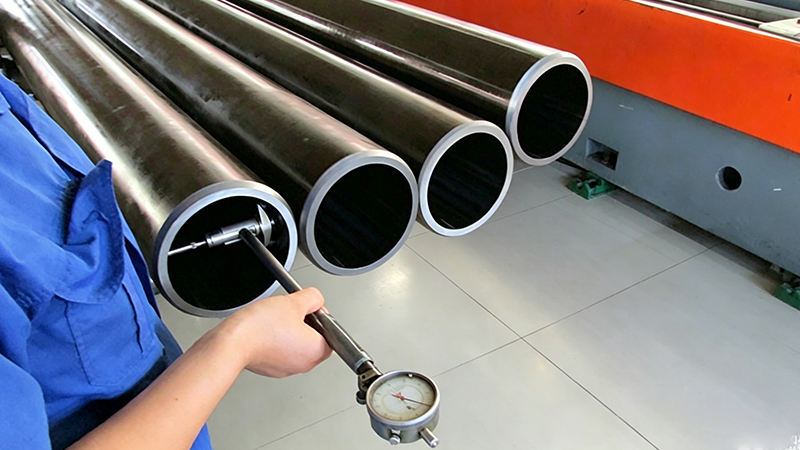
Inspection confirms compliance. Production confirms capability.These two measurements should never be considered interchangeable.
A supplier may consistently pass dimensional inspection while still creating unnecessary variation during machining or assembly. Likewise, a supplier with stable manufacturing processes often contributes to lower production costs even if their quotation is not the lowest.For purchasing teams supporting hydraulic cylinder production, evaluating long-term manufacturing performance is usually more valuable than comparing unit price alone.
The lowest quotation is not always the lowest manufacturing cost.
Looking beyond price before placing the first order often prevents far greater costs after production begins.
Supplier approval is one of the few decisions that influences every department inside a manufacturing company.Purchasing focuses on cost.Quality focuses on compliance.Production focuses on efficiency.Engineering focuses on reliability.A successful supplier supports all four objectives at the same time.
Before approving a new supplier for Honed Tubes or Chrome Plated Rods, it is worth asking not only whether the products meet specification, but also whether the supplier can deliver the same level of manufacturing consistency month after month.
That single question often separates a successful partnership from a costly supplier change.
No. Price is important, but production consistency, delivery reliability, and manufacturing capability often have a greater impact on total manufacturing cost.
Consistent materials help maintain stable machining, predictable assembly performance, and repeatable product quality across multiple production batches.
Depending on project requirements, purchasing teams may request material certificates, dimensional inspection reports, traceability records, and quality documentation that supports production consistency.
Many manufacturers begin with sample production, compare machining performance, review inspection data, and collect feedback from production and quality teams before approving long-term supply.
Not always. Inspection confirms compliance with specifications, but long-term supplier performance should also consider manufacturing stability, communication, delivery consistency, and technical support.
Because engineers and production teams often identify manufacturing risks that are not visible in quotations or inspection reports.
Choosing a supplier is more than comparing quotations. It is about selecting a manufacturing partner that can support stable production over the long term.
At EAST AI, we manufacture Honed Tubes and Chrome Plated Rods with an emphasis on batch-to-batch consistency, process control, and production repeatability. If your team is evaluating new suppliers or reviewing supplier performance, we are happy to discuss technical requirements, manufacturing considerations, and practical solutions based on real production experience.